Showing posts with label Conservative. Show all posts

Thursday, July 28, 2011

The Boehner Plan: Bad for Conservatives, Bad for the Republican Party, Bad for America

In my last post, I wrote about how the current debt deals, Cut, Cap and Balance mostly, are showing the problem with “Conservatives” (not really conservative, but that will be discussed in an upcoming post, Heritage Conservatism: The End of Conservatism?).  In this post I will be writing about why the Boehner Plan is in no way conceivable, conservative and why the best option is Cut, Cap and Balance.  In case you are reading this from a deserted island, the Boehner plan I speak of is Republican Speaker of the House, John Boehner’s debt limit plan.  His plan calls for “$1.2 trillion” in cuts, which was later found out to be actually $850 billion in cuts.  The plan also doesn’t actually include cuts; it does limit discretionary spending over the next ten years, but doesn’t actually cut anything.  You may be asking, “Then why does the Speaker get to call them cuts?” The answer: the “cuts” in the Boehner plan are only “cuts” from the CBO baseline, which is an imaginary path of future spending designed as a planning tool for Congress. Boehner can propose to spend any amount in any future year he wants, and in this plan he chooses to have a steadily rising spending path. The Boehner plan also only “cuts” $6 billion from the FY2012 budget, which is $105 billion short of Cut, Cap and Balance. Most importantly, the Boehner plan doesn’t lead to a Balanced Budget Amendment like Cut, Cap and Balance does.  A true conservative plan would involve, at a minimum, sending the Balanced Budget Amendment to the states along with statutory caps on spending to restrain Congress while the Balanced Budget Amendment is being ratified.  Cut, Cap and Balance, while not the perfect plan (see last post), is the best available option to get a Balanced Budget Amendment to the states, which should be the goal of these negotiations. 

The Boehner Plan doesn’t cut, cap or balance (Bad for Conservatives), the Boehner Plan doesn’t fulfill the promise of $100 billion in cuts that the Republican Party promised in the last election (Bad for the Republican Party) and the Boehner plan raises the debt ceiling without getting anything real in return (Bad for America).  To sum it up, The Boehner Plan is Bad for Conservatives, Bad for the Republican Party and Bad for America.

Tuesday, July 26, 2011

Debt Limit Talks showing the problem with “Heritage Conservatism”

The last few weeks, along with the next two, have been pretty exciting here in D.C.  Both sides are trying to haggle their way into getting what they want.  The Democrats (and some Republicans) want to raise taxes and “cut” spending (yeah right), the Republicans want to cut spending and pass Cut, Cap and Balance (which, in theory, includes passage of the balanced budget amendment).  A lot of my fellow libertarians have been very vocal about not liking Cut, Cap and Balance and saying that we cannot under any circumstance, raise the debt limit.  While this sounds great in theory, it falls a tad bit short in reality.  The truth is that the debt limit is going to have to go up, BUT we also need to get something for it and that is where Cut, Cap and Balance comes in.

So far, Republicans (the ones not in the Gang of Six) have held up well against the idea of tax increases and minimal cuts, but they also are still stuck in the mode of no cuts to defense.  This is simply not acceptable.  Recently, the Heritage Foundation released a Web Memo titled, “Cut, Cap and Balance Makes Sense – So Does Providing Adequate Support for Defense.”  By “adequate support” they mean a minimum of $720 billion a year.  WOW!!! If that’s what adequate is, damn! 

In the Web Memo, Heritage states:

"Thomas Jefferson once said that “the price of freedom is eternal vigilance.” Today, as has always been the case, the cause of liberty is under assault. Internationally, authoritarian states and the supporters of Islamist extremism in non-state groups seek to use violent coercion to extinguish liberty everywhere. Failing to prepare for these threats would not only weaken U.S. national security but undermine the international security of world commerce and trade if the U.S. is unable to defend the open seas and maintain a global military presence."

This suggests that it is the job of the United States to defend liberty everywhere, no matter the cost in dollars or lives of our troops.  This is exactly the problem with modern conservative movement, it has been hijacked by this “Heritage Conservatism.”  The very fact that they dare use a quote by Thomas Jefferson to justify spending 100s of billions a year on a massive empire defies all common sense and logic. 

To get back to the debt limit talks, it is vital that Republicans realize that spending “adequately” on defense is not quite adequate.  Republicans must put every kind of spending on the chopping block including defense spending.  Cut, Cap and Balance is a good plan and our best chance at a Balanced Budget Amendment and real spending cuts, but it needs to include defense cuts.

Thursday, May 5, 2011

Let's get Serious about Cutting Spending (Defense Spending)

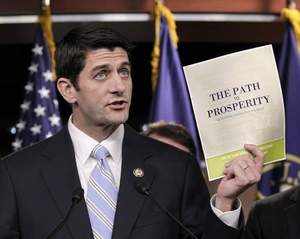
A few weeks ago, Congressmen Paul Ryan released his vision for the future in the form of a budget that cuts $4-6 trillion and pays off the national debt by 2050.  While I commend Congressmen Ryan for his vision, more needs to be done.  In the budget, their was no mention of Social Security reform or Defense cuts.  To be fair, Ryan has a proposal for Social Security reform that would turn the system over to a privatized personal account based system but this reform didn’t make the budget because of the reality that Republicans only control one house of Congress.  This proposal is a great step forward and will be pursued, I would assume, after the 2012 election cycle.  What should be pursued now is defense spending cuts, which outside of the entitlement programs (all together) is the biggest expenditure in the budget.  

Currently, the U.S. spends over $700 billion in defense per year and operates over 700 bases in more than 135 countries around the world.  If you calculate all defense spending around the world and compare that number to the United States’ number, the U.S. spends 42.8 percent of all world spending of defense.  The next highest percentage is China at 7 percent.  This number is a very conservative number because the number does not include the majority of the Department of Homeland Security, and any interest on the debt that is defense related.  Clearly, this is an area of spending that needs to be addressed.

Before I get into specifics of what should be cut and how to cut.  First we need to realize that MAJOR reforms should come first.  By this I mean withdrawing troops from both Iraq and Afghanistan and ending this ridiculous “military action” (pronounced undeclared war) against Libya.  Also, the Department of Homeland Security needs to be eliminated and the agencies within in either cut completely or merged with other agencies that have similar objectives.  Also, the intelligence community is in desperate need of major reforms.  Currently their are 16 (that I could find, probably more) intelligence agencies.  Let’s start out be whittling that number down to five- the CIA, FBI, DEA (technically an considered intelligence agency), and for the final two: an Army intelligence agency and a Navy intelligence agency.  Also keep in mind that that I am for an end to the war on drugs and the DEA, but small steps.  Now each of the agencies need massive and major reforms to streamline intelligence, but I am not by any means an expert on this issue, so I’ll stop at just saying we need reforms.  Other smaller, yet very important reforms that won’t necessarily save a lot of money are also needed.  Most importantly, this means completely abolishing the draft and repealing the PATRIOT Act.

Now lets take a look at defense cuts.  Currently, Defense spending accounts for approximately 5 percent of GDP, while before 9/11 it accounted for approximately 3 percent of gdp, with a 45 year average of 5.3 percent.  To start out, let’s cut 10 percent of defense spending the first budget cycle (2012 budget).  This cut should also be applied to every federal department and agency as a starting point, but that is an issue for another upcoming blog post.  Getting back to defense, after the initial 10 percent cut, the entire Department of Defense needs to thoroughly audited and be assessed in terms of what spending is essential and what is not.  This audit should be done by a non-governmental firm, of course all precautions will be taken to secure classified information, and each of the military bases oversees should be paid special attention to in this audit.  After completion of this audit, pull out your machete, because its slashing time.  At a very minimum, defense spending should be rolled back to 2000 levels (3 percent of gdp), this cut would occur over a period of 5 years.  Critics (most of which will be Republicans) will say that a cut that size will leave the the U.S. vulnerable to attack.  These critics will probably suggest a defense budget at that or around that 5.3 percent 45 year average.  The problem with that number is that for most of that 45 year stretch, the U.S. was engaged in the Cold War with a Communist threat in the Soviets and if you haven’t noticed, we no longer are in that situation.  High defense spending was necessary to defeat the Soviets, but no longer is.  What Reagan did (increasing defense spending) was needed and caused the Soviets to decay and rot from the inside.  Most Republicans now have this notion that high defense spending means better and more security, but that simply doesn’t jive with the rest of conservative thought and belief. Conservatives believe (and know) that more spending programs such as the War on Poverty and massive spending in education doesn’t make those programs better, it in fact in those instances, it made the problem worse.   

The battle for the control over spending and the debt has many fronts, but one of them must be Defense cuts.  The Ryan budget is a great first step, but defense spending must also be included in cuts to the budget.  In this article, I have mostly talked about spending cuts and not sweeping reforms in foreign policy, but reforms are just as important because they change how we spend taxpayer dollars on defense.  These reforms are not easy and will not be easy to implement.  One example is ending all foreign aid and not propping up countries like Israel and giving money to their enemies.  These policies are destructive to both our security and Israel’s.  The U.S. can no longer afford to be the police of the world and simply can’t afford to pay for the defense of other countries. Organizations such as NATO and the United Nations delegitimize our sovereignty and our security. Despite what many conservatives believe, terrorists don’t attack us because of what we believe, they attack us because we support the governments that oppress them.  The former head of the CIA’s Bin Laden Unit, terrorism expert Michael Scheuer stresses that they come here precisely because we are over there.  Scheuer stated, “On no other foreign policy issue since the Cold War’s end has the truth been so easy to establish on the basis of hard facts but so hard for Americans to see...that Muslim hatred is motivated by U.S. interventionism more than any other factor.”  If terrorists did attack us for our freedom, prosperity or religion why wouldn’t they attack a more economically free country such as Liechtenstein or Hong Kong or the home of Christian faith, the Vatican.  As I’ve already stated, these solutions are not easy, but they are essential to paying off our debt and to our security and our liberty.

Monday, April 25, 2011

Why People are Dumb and a Remedy for it

A while back, one of my friends wrote a blog post on his blog titled “Are People Dumb?.”  In this post, my friend quoted both John Stuart Mill from his very well known work Utilitarianism, which supports my argument and then he quoted Thomas Sowell from his work Intellectuals and Society, which supports his.  It is important to say, that I believe individuals are smart and rational people that make good decisions most of the time, however people (as in “the masses”) are, most of the time, irrational and generally, for the sake of the name of this article, dumb.  Now, before you get your pitchfork and run me out of town, let me explain my logic and what the remedy is to fix it.  

The reason I think people are dumb surrounds us, just look at what people watch on television, shows like Jersey Shore kind of proves my point.  But if you’re still not convinced (although watching Jersey Shore once should be enough) let’s examine what the founding fathers thought about the masses.

The founding fathers set up an entire government that would keep important decisions away from the people at large and put those decisions into the hands of a selected few (while also leaving most governmental powers to the states not the federal government).  That’s why the founders put the election of the Senate, the most important branch of the legislative branch, into the hands of the legislative bodies of each state and not into the hands of the people.  The reasoning for this is that the founding fathers were aware of the tragedy of history, that history tends to repeat itself.  Time and time again, democratic societies have given way to tyranny.  The example the founding fathers referred to most was the example of the Roman Empire which slowly gave it’s democratic process to the bureaucrats, the last one being Julius Caesar.  This is why the Founders were afraid of the people and how easy it is for them to be deceived by demagogues.  Just look at the modern example of Hitler and Nazi Germany and you will understand.  In fact in this country, all of the federal encroachments on liberties have been with the people’s consent and approval.  For instance the passage of the 17th amendment came from a populist movement of the people who thought the direct election of Senators would be in their best interest, when in fact it would be the exact opposite.  Thanks to the 17th amendment, the states did not have a say in any of the entitlement programs that bribed the people into voting for the re-election of the senators elected by the people directly.

Now that you’re good and depressed about how dumb people are and how they will vote for hope and change and then have only lint left in their pockets, there is actual hope.  It’s called the Constitution.  A return to the constitution and it’s principles of limited government will cure the ills of big government. 

Our current system has introduced moral hazard into society where people don’t have to take responsibility for their actions and can instead live on government handouts and the backs of the productive members of society.  It is also important to note that I have great faith in individuals and their ability to make rational choices and make decisions that are beneficial to society and the free market; this is why I believe in personal liberty and not government tyranny.  With a return to a constitutional government, we can take out the problems of our current system which depends too much on handouts for all and not on individuals making rational choices for their own betterment.

Thursday, April 7, 2011

Slash or Burn

Liberals these days like to accuse conservatives of "slash and burn" policies that "kill Old people and children."  The truth is that we MUST Slash and Burn our budget or our government will go bankrupt and default.  In about 24 hours, the time will run out on the Continuing Resolution is that is currently funding our government and the government will effectively shutdown (although government slowdown is a better term).

Currently House Republican leadership, Senate Democrat leadership and the White House are trying to work out a deal for another CR or a complete budget.  The Senate Democrats proposed a $33 billion budget that Speaker John Boehner rejected and the White House has promised to veto a one week $12 billion cut from the House.  But their is a major problem with all of these proposals . . . it is not near enough.  During the last campaign, House Republicans promised $100 billion in cuts and now Boehner is pushing $61 billion in cuts.  Note to Boehner and all Republicans: 61 is NOT the same as 100, you're about $39 billion off.  I propose that if House Republicans cave and cut less than the promised $100 billion we burn them by not voting for their re-election.  This budget is too important to only cut 33 or 61 billion, we must at the very least, cut the promised $100 billion. 

The truth is that $100 billion is not enough, radical and drastic cuts must be made NOW.  Several months ago, Senator Rand Paul proposed a $500 billion cut and the Cato Institute proposed a $1.06 trillion cut and Paul Ryan has a 2012 budget proposal that would cut between 4 and 6 trillion over 10 years.  These are real cuts, drastic cuts, needed cuts.  The Cato proposal would balance the budget by 2020, the Ryan proposal by 2050.


I would also like to propose a deal on the debt ceiling and the 2011 budget: No deal on either without the passage in the House and Senate, signing by the president and ratification by the states of the Balanced Budget Amendment as proposed by Senator Mike Lee.  This will force Congress to cut spending to 18% of GDP (currently hovering around 25%), make desperately needed reforms to Social Security, Medicaid and Medicare and start to pay down the national debt that is currently at a staggering $14 trillion.

The time to act is now, not 5 years from now, RIGHT NOW!  For years politicians from both sides of the isle have been kicking the can down the road on spending cuts, and now one more kick will result in that can and person kicking it to plunge down the massive hole at the end of the road.  If the cuts that were promised to us are not instituted, it's time to Slash and Burn anyone, including my own Congressmen, who voted for cuts less than the promised $100 billion.

Monday, February 21, 2011

The Neo-Con Disease

In today’s conservative movement, one particular sect of the movement is plaguing the entire movement, neo-conservatism.  While many think this “new” ideology is just a foreign policy, I am sad to say that it is much more than that.  Neo-conservatism has become a complete ideology that pushes conservative ideals through big government.  Many believe that this movement of conservatism started with Irving Kristol and then spread to Richard Nixon where it became viral and spread throughout the conservative movement.  The problem with this analogy is that neo-conservatism has a much longer history; it in fact began with the policies of Theodore Roosevelt and the progressive movement.

President Theodore “Teddy” Roosevelt, a man who many neo-cons idolize (including William and Irving Kristol) was not a conservative that some say he was.  Roosevelt dramatically changed America’s foreign policy from what the founders had envisioned.  Roosevelt advocated for an imperialist America that would no longer continue the policy of commercial relations with all nations and entangling alliances with none.  Roosevelt also had a profound impact on economic policy by “trust-busting,” in other words; Roosevelt intervened into a high-functioning free-market economy to break up companies that provided needed competition.  Roosevelt imposed price controls on the railroads, supported hyper-protectionist tariff policies, and drummed up a fake food crisis to create new regulations that only protected the large food corporations and not the consumers.  Roosevelt was also seen by neo-cons and liberals alike (hmm . . . could there be a similarity between the two) as the first “green” politician and conversationalist.  He was in fact, very much not.  Roosevelt’s “green” policies included wasting massive amounts of tax dollars on damns that flooded canyons and rivers, national foresting policies contributing to overgrazing and massive forest fires and a his policies to oppose the privatization of government land.  But perhaps Roosevelt’s worst policy implication was his revival the income tax, an idea he advocated for strongly and was passed under Roosevelt’s progressive successors.

Although Roosevelt did not start the neo-conservative movement, he was the father of the movement.  The neo-conservative ideology wouldn’t be official until Richard Nixon and Henry Kissinger took office in the late sixties.  Nixon fully developed the neo-conservative foreign policy with the Vietnam War and his Détente strategy that called for more government and a beginning of the neo-conservative nation building policies.  Nixon also tried Keynesian economic policies that included price controls on oil among other goods and also ended the link between the dollar and gold which permanently took the U.S. off any reminisce of the gold standard it once held.  Nixon is also the president responsible for the EPA, OSHA, federal affirmative action, national drug laws, and piles of graft and federal interventions in every direction.  These are policies that Richard Nixon handed down to his new breed of statist conservatives (wait a minute, can those two words exist in the same sentence?).

Neo-conservatism would continue to grow under men like Bill and William Kristol of the Weekly Standard (the neo-conservative powerhouse magazine), Democratic New York Senator Daniel Patrick Moynihan, ‘Conservative’ talk show host Sean Hannity and the culmination of the neo-conservative ideology – George W. Bush. 

Bush completed the link between the neo-conservative foreign policy and domestic policy.  Bush’s foreign policy (The Bush Doctrine) consisted of high defense spending along with spreading democracy across the globe came together with “big government conservatism” such as Medicare part B, the formation of the Department of Homeland Security, No Child Left Behind, and Faith-Based initiatives.  All of these policies push conservative causes through the expansion of federal powers and more government spending.  What made it worse was Bush’s continual talk of himself as a constitutional conservative; all the while he uses the constitution as toilet paper.  Acts such as the PATRIOT Act, quite possibly the most unconstitutional act ever passed by Congress, highlight Bush’s (and neo-conservatives) disregard for both the constitution and the conservative ideology. 

Perhaps the worst policy of the neo-conservative ideology is that of nation building.  The policy is to build democracies in areas where there wasn’t one before.  Although some traditional conservatives may think this is a good idea, it is actually a deeply flawed one both in the terms of the conservative agenda and in the terms of government spending.  The basis for nation building is to free the people in totalitarian states.  The problem with it is that people must choose on their own to form a free society.  They must set up a social contract with each other and choose freedom, something that must be chosen by a free people or it simply isn’t freedom.  Freedom without a choice is not freedom at all, but just another form of enslavement.  Nation building also created an enormous amount of government spending, spending that has to be paid for in one form or another.  The current form of paying for this policy is that printing fake money.  The simple truth is not only is nation building a bad policy for conservatives, and it’s a bad policy for America.  The Iraq/Afghanistan war has cost a minimum of $1.5 trillion with some estimations in the $3 trillion range.

Nation Building is only one consequence of neo-conservatism, but so far it is the most costly effect.  Other neo-conservative policies such as the EPA and No Child Left Behind have also been costly, although nowhere in the range of the Iraq War.  Now the question is what to do about this plague.  Fortunately for conservatives there is a cure; it comes in the form of a document that was written over 200 years ago, the Constitution.  Conservatives must educate not only society, but members of its own movement (especially those who follow the neo-conservative ideology) what the Constitution stands for: a truly limited government, a non-interventionalist foreign policy, spending within its means, individual liberty and enforcing the rights of states.  If the conservative movement is to survive, we must return to true conservatism. What I am calling for is an alliance of Libertarians, Economic Conservatives, Social Conservatives and Traditional Conservatives to take back the conservative movement.  We must look back at our heritage and remember the polices of men like Thomas Jefferson, Grover Cleveland, Calvin Coolidge, Robert Taft, Barry Goldwater and Ronald Reagan and condemn the polices of Theodore Roosevelt, Richard Nixon, George W. Bush and Mitt Romney.  This last election showed us that the American people are ready to embrace true conservative ideals.  The time to act is now, for liberty, for the constitution, for America.